The TP-Link USB WiFi 6 Adapter review centers on the Archer TX20U Plus, a desktop-oriented way to add dual-band WiFi 6 through USB 3.0.
Its adjustable antennas and one-meter cable give it more placement flexibility than a small adapter that sits directly in a port.
Archer TX20U Plus Review Summary
The quick verdict
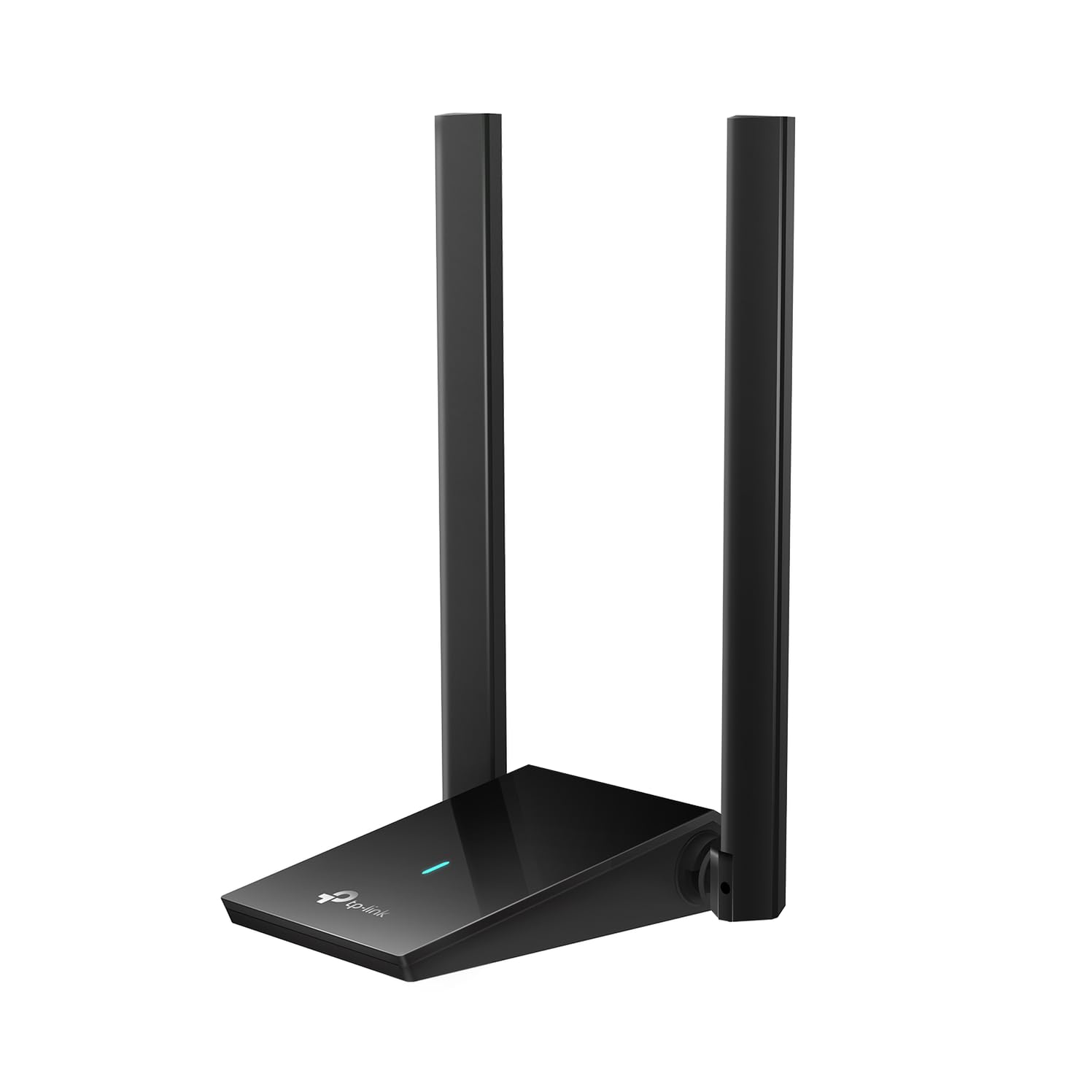
10,000+ ratings
Read Amazon ReviewsTP-Link Archer TX20U Plus
A practical option for Windows desktop owners who want dual-band WiFi 6, adjustable antennas, and flexible USB placement.
- WiFi 6 (802.11ax) USB adapter designed for desktop PCs.
- Dual-band wireless: up to 1,201 Mbps on 5GHz and up to 574 Mbps on 2.4GHz.
- Two high-gain antennas with adjustable, multidirectional positioning and beamforming.
- Supports MU-MIMO and OFDMA for handling wireless traffic in supported networks.

Pros
- Combines WiFi 6 with both common WiFi bands, offering flexibility across compatible routers and network conditions.
- The adjustable dual antennas and cable allow the adapter to be positioned for reception rather than fixed at the back of a desktop.
Consider before buying
- Its maximum wireless rates depend on compatible network equipment and conditions; they do not guarantee equivalent internet throughput.
- The design and cable are more oriented to desktop placement than to a compact, unobtrusive adapter.
Read the full review summary
The Archer TX20U Plus combines WiFi 6 with 2.4GHz and 5GHz connectivity, rated for up to 574 Mbps and 1,201 Mbps respectively.
Those are maximum link rates rather than a promise of internet speed, but the two-band design gives a compatible desktop more options for connecting to a modern wireless network.
Its high-gain antennas, beamforming, MU-MIMO, and OFDMA support are aimed at improving reception and managing traffic in busy wireless environments.
It is best suited to Windows 10 or 11 desktop owners who can use a USB 3.0 port and benefit from positioning the adapter away from the computer case.
Mac users should check the driver installation requirements before choosing it.
The buying factors
Archer TX20U Plus Scorecard
Editorial scores reflect listed features and buyer fit; they are not laboratory measurements or customer ratings.
WiFi 6 capability
Adds 802.11ax connectivity with a stated combined maximum of up to 1.8 Gbps across its two bands.
Band flexibility
Offers both 2.4GHz and 5GHz, with separate maximum link rates for each.
Antenna and placement design
Two adjustable high-gain antennas and a one-meter USB cable allow flexible positioning.
Congestion features
MU-MIMO and OFDMA support are relevant to networks handling multiple connected devices.
Security support
WPA3 support provides a current security option when the network also supports it.
Setup compatibility
Windows 10 and 11 are supported; Mac setup requires manual driver upload, so compatibility deserves a check.
Key Features and Specifications of Archer TX20U Plus
- WiFi 6 (802.11ax) USB adapter designed for desktop PCs.
- Dual-band wireless: up to 1,201 Mbps on 5GHz and up to 574 Mbps on 2.4GHz.
- Two high-gain antennas with adjustable, multidirectional positioning and beamforming.
- Supports MU-MIMO and OFDMA for handling wireless traffic in supported networks.
- Supports WPA3 encryption when used with a compatible network.
- Includes a one-meter USB 3.0 cable for flexible adapter placement; USB 3.0 is recommended for optimal performance.
- Supports Windows 10 and Windows 11; Mac OS requires manual driver upload.
Pros and Cons of Archer TX20U Plus
Pros
- Combines WiFi 6 with both common WiFi bands, offering flexibility across compatible routers and network conditions.
- The adjustable dual antennas and cable allow the adapter to be positioned for reception rather than fixed at the back of a desktop.
- Includes modern network features such as WPA3, MU-MIMO, and OFDMA.
- A clear fit for upgrading a desktop through USB without installing an internal network card.
Consider before buying
- Its maximum wireless rates depend on compatible network equipment and conditions; they do not guarantee equivalent internet throughput.
- The design and cable are more oriented to desktop placement than to a compact, unobtrusive adapter.
- Mac users need to account for manual driver upload, while Windows support is explicitly listed for versions 10 and 11.
- Using a USB 3.0 port is recommended, so check that a suitable port is available where the adapter will be placed.
Who Should Buy Archer TX20U Plus?
Good fit
Consider the Archer TX20U Plus if a Windows desktop needs wireless networking or a WiFi 6 upgrade and has an available USB 3.0 port.
The cable and adjustable antennas are useful when the computer’s rear ports are tucked against a wall or surrounded by cables, since they let you move the adapter to a more convenient position.
It also makes sense if you want dual-band support and your router can use WiFi 6.
The listed rates of up to 1,201 Mbps on 5GHz and 574 Mbps on 2.4GHz describe wireless link ceilings; your actual connection will depend on the router, internet plan, distance, and local wireless conditions.
Before buying, confirm that the operating system and installation approach suit your computer. The supported Windows versions are 10 and 11, and the product information notes that Mac OS requires manual driver upload.
Who should skip it
Skip it if you need an adapter for a computer without a usable USB 3.0 port, or if you want a very small device that stays plugged directly into the PC with no separate cable or antenna assembly.
If your computer runs Mac OS, first make sure you are comfortable with the manual driver-upload requirement and can obtain a compatible driver for your setup.
How the Archer TX20U Plus Fits a Desktop WiFi Upgrade
Two bands for different connection choices
The adapter connects on either 2.4GHz or 5GHz.
The 2.4GHz band has a lower listed maximum rate, while 5GHz has the higher one; having both available lets the network and user choose a suitable band rather than limiting the PC to a single frequency.
Antenna positioning matters
The two adjustable antennas and one-meter cable make placement a central part of this design. Rather than leaving the adapter pressed against the rear of a desktop, a buyer can try positioning it with clearer space around it.
The antennas and beamforming are intended to support signal quality, though results still depend on the surrounding network and environment.
WiFi 6 features work with a compatible network
The adapter supports 802.11ax as well as MU-MIMO and OFDMA.
These features are most relevant when paired with compatible networking equipment; they do not change the speed of an internet plan or make every connected device operate at the adapter’s maximum rate.
Check installation before choosing
The stated operating system support covers Windows 10 and 11, including 32-bit and 64-bit versions. Mac OS requires manual driver upload, so Mac buyers should verify the driver path for their specific setup.
The product information also recommends using USB 3.0 and disabling the computer’s internal WiFi before installation.
Alternatives to Archer TX20U Plus
No alternative model is recommended here. Compare the antenna design, connection type, and operating system support that matter to your setup before choosing another adapter.
Is Archer TX20U Plus Worth It?
The TP-Link Archer TX20U Plus is worth considering for a Windows desktop owner who wants dual-band WiFi 6 and would benefit from placing antennas away from the computer.
Its cable, adjustable antenna design, and supported network features make it a more flexible desktop-style option than a port-only approach.
Buy it if your computer has a USB 3.0 port and the stated operating system support fits your setup. Treat the maximum wireless rates as ceilings, and check driver requirements first if you use Mac OS.
Your review at a glance
10,000+ ratings
Read Amazon ReviewsTP-Link Archer TX20U Plus
A practical option for Windows desktop owners who want dual-band WiFi 6, adjustable antennas, and flexible USB placement.
- WiFi 6 (802.11ax) USB adapter designed for desktop PCs.
- Dual-band wireless: up to 1,201 Mbps on 5GHz and up to 574 Mbps on 2.4GHz.
- Two high-gain antennas with adjustable, multidirectional positioning and beamforming.
- Supports MU-MIMO and OFDMA for handling wireless traffic in supported networks.